
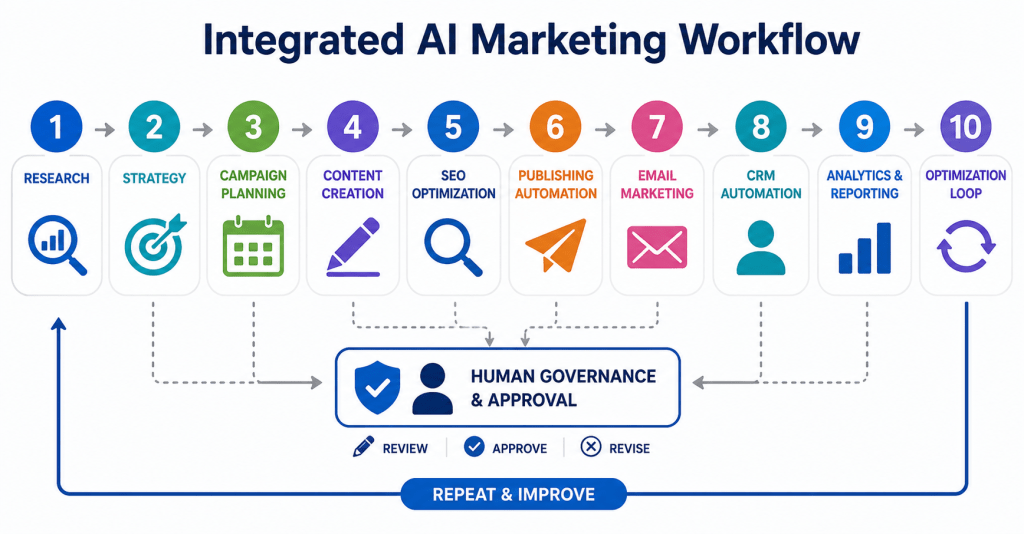
For years, marketing has been viewed as a team sport. Businesses typically needed strategists, copywriters, designers, SEO specialists, social media managers, email marketers, CRM administrators, and analysts to execute a successful marketing program.
Today, artificial intelligence is changing that model.
While AI doesn’t replace strategic thinking or human creativity, it can automate much of the repetitive work involved in planning, creating, publishing, and optimizing marketing campaigns. For solo marketers and small businesses, this means it’s now possible to operate like a much larger marketing department—with AI acting as a team of specialized assistants and you serving as the director.
Instead of spending your time creating every asset manually, your role becomes defining objectives, reviewing outputs, approving decisions, and continuously improving performance.
Think of AI as Your Marketing Team
Rather than using a single AI chatbot, imagine managing a team of AI specialists, each responsible for a different function:
- Research Analyst
- Marketing Strategist
- Campaign Manager
- Content Writer
- Graphic Designer
- Video Producer
- SEO Specialist
- Social Media Manager
- Email Marketing Specialist
- CRM Administrator
- Data Analyst
- Marketing Operations Manager
Each AI “team member” performs a specific task, while you ensure everything aligns with your brand, goals, and customer needs.
Step 1: Let AI Handle Market Research
Every successful marketing campaign starts with research. Instead of spending days gathering information manually, AI can quickly analyze competitors, industry trends, customer feedback, online discussions, and keyword opportunities.
Research can include:
- Competitor positioning and pricing
- Customer pain points
- Product reviews
- Reddit and LinkedIn conversations
- Emerging market trends
- SEO keyword opportunities
This research forms the foundation for better marketing decisions and provides insights that would normally take hours—or even days—to compile.
Step 2: Transform Research into Marketing Strategy
Once research is complete, AI can help convert information into an actionable marketing strategy.
It can generate:
- Ideal Customer Profiles (ICPs)
- Buyer personas
- Brand positioning
- Messaging frameworks
- Customer journey maps
- Campaign ideas
- Content pillars
- Quarterly marketing plans
- KPI recommendations
Instead of starting with a blank page, you begin with a well-structured strategy that can be refined and tailored to your business.
Step 3: Plan Integrated Marketing Campaigns
Modern marketing isn’t about creating isolated pieces of content. Every campaign should produce multiple coordinated assets.
For example, a single product launch might include:
- Landing page
- Blog article
- Email sequence
- LinkedIn posts
- Instagram content
- Video script
- Google Ads
- Facebook Ads
- Customer FAQ
- Sales enablement materials
AI can generate a complete campaign plan with timelines, deliverables, target audiences, success metrics, and publishing schedules.
Step 4: Scale Content Creation
Content creation is often the most time-consuming part of marketing. AI dramatically reduces this workload by transforming one core idea into multiple pieces of content.
A single product announcement can become:
- A detailed blog article
- Multiple LinkedIn posts
- Social media captions
- Email newsletters
- Website copy
- Press releases
- Video scripts
- Podcast outlines
- Case studies
- Frequently asked questions
- Advertising copy
- SEO landing pages
This “create once, distribute everywhere” approach allows solo marketers to maintain a consistent presence across multiple channels without constantly producing new material from scratch.
Step 5: Accelerate SEO Content Production
AI also streamlines search engine optimization by assisting with:
- Keyword research
- Topic clusters
- Content briefs
- First drafts
- Meta descriptions
- Internal linking suggestions
- Schema markup
- Content refresh recommendations
Rather than publishing only a handful of articles each month, businesses can significantly increase their publishing cadence while maintaining editorial oversight to ensure accuracy and quality.
Step 6: Automate Publishing
Publishing should no longer require manually posting content to every platform.
Workflow automation tools can automatically distribute new content across:
- Company website
- X (formerly Twitter)
- Threads
- Email newsletters
Publishing workflows can also notify internal teams, update CRM records, and trigger follow-up automations, ensuring every piece of content reaches the right audience at the right time.
Step 7: Personalize Email Marketing
Email remains one of the highest-performing marketing channels, and AI makes it easier to create personalized customer journeys.
AI can help develop:
- Welcome sequences
- Lead nurturing campaigns
- Educational email series
- Product announcements
- Upsell campaigns
- Re-engagement campaigns
- Monthly newsletters
It can also suggest subject lines, personalize content for different audience segments, recommend send times, and generate A/B testing variations.
Step 8: Keep Your CRM Up to Date Automatically
Marketing doesn’t end when someone downloads a resource or submits a form.
With CRM automation, AI can:
- Tag new contacts
- Score leads
- Assign audience segments
- Trigger welcome emails
- Launch nurture campaigns
- Notify sales teams
- Update customer records
- Schedule follow-up activities
This reduces manual administration while ensuring every lead receives timely and relevant communication.
Step 9: Turn Data into Actionable Insights
Many marketers spend hours building reports. AI can instead summarize performance and highlight what matters most.
Daily reports might include:
- Website traffic
- Leads generated
- Email performance
- Conversion rates
- Advertising performance
- Sales pipeline activity
Weekly and monthly summaries can identify successful campaigns, underperforming channels, and optimization opportunities, allowing you to make faster, more informed decisions.
Step 10: Build a Continuous Optimization Loop
The most valuable aspect of AI isn’t automation—it’s continuous improvement.
As campaigns run, AI can:
- Analyze performance data.
- Identify patterns and trends.
- Recommend optimizations.
- Generate new content variations.
- Support A/B testing.
- Measure results.
- Repeat the process.
This creates an ongoing cycle of learning and optimization that helps marketing become more effective over time.
The Modern Role of a Solo Marketer
With AI handling much of the operational work, the role of the marketer evolves.
Instead of spending every day writing content, scheduling posts, and compiling reports, your responsibilities become:
- Defining business objectives
- Setting marketing strategy
- Reviewing AI-generated work
- Protecting brand quality and consistency
- Approving campaigns
- Monitoring performance
- Making strategic decisions
In other words, you become the conductor of an AI-powered marketing team.
A Practical AI Marketing Stack
A streamlined technology stack might include:
- ChatGPT for strategy, planning, and writing
- Claude for long-form analysis and documentation
- Perplexity for market research
- NotebookLM for organizing knowledge
- Canva AI for design
- Runway or Veo for video creation
- Ahrefs or Semrush for SEO
- Buffer for social publishing
- HubSpot for CRM and email marketing
- n8n or Make for workflow automation
- Looker Studio for reporting
Final Thoughts
Artificial intelligence isn’t replacing marketers—it is reshaping how marketing gets done.
For solo marketers, entrepreneurs, and small businesses, AI offers the opportunity to operate with the capabilities of a much larger team. By automating repetitive tasks and connecting research, strategy, content creation, publishing, CRM, email marketing, and analytics into one integrated workflow, you can spend less time executing and more time thinking strategically.
The future of marketing isn’t about doing everything yourself. It’s about building an AI-powered operating system that executes efficiently while you provide the vision, judgment, and creativity that only humans can deliver.

